💬
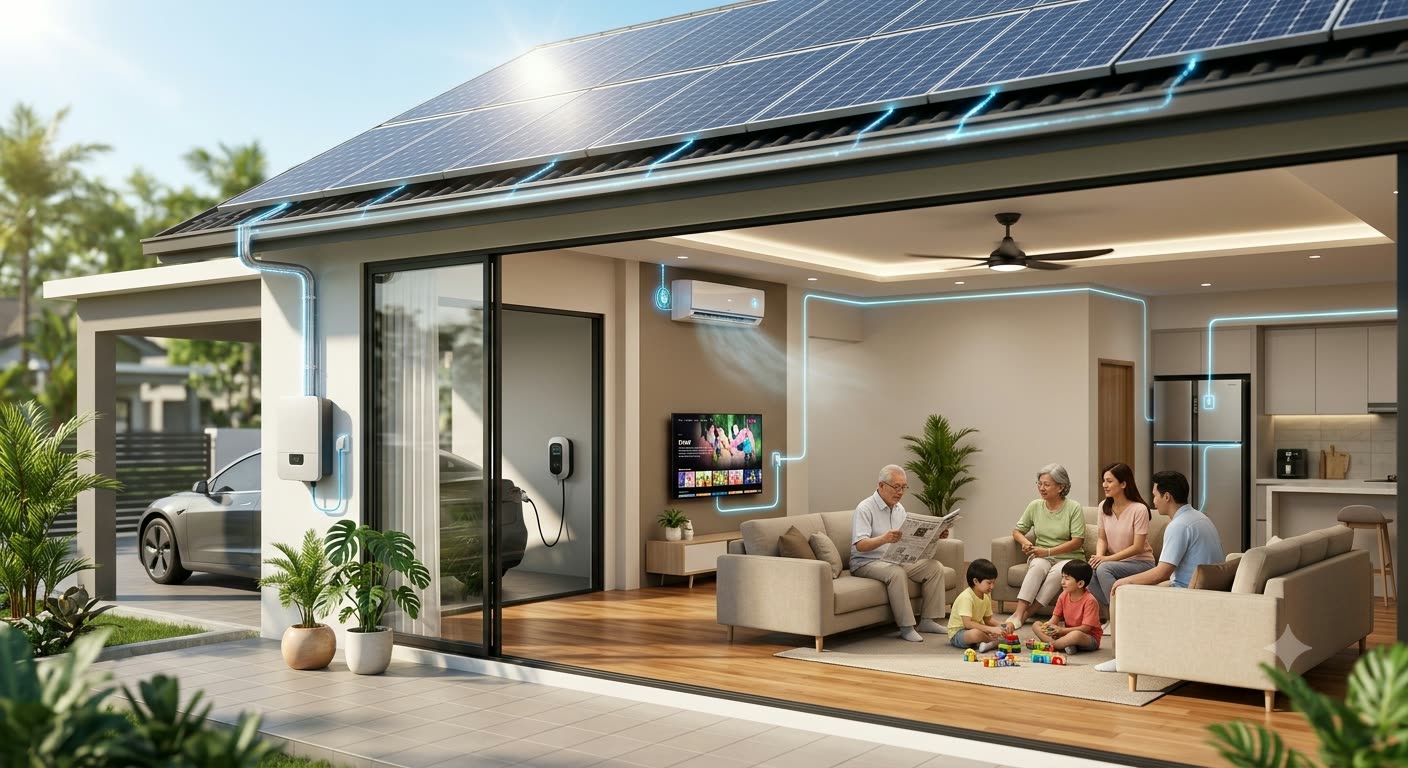
A Malaysian family relaxing at home with rooftop solar and an electric car
SuRIA Programme Period · 250MW National Quota Time is Running Out · loading…
NewRM3,000 SuRIA rebate is now live

Power Your Home.
Uplift the Nation.

Turn Malaysian sunshine into a smaller TNB bill. SEDA-registered installers, Tier-1 panels, and we handle your entire RM3,000 rebate claim.

SEDA registered 1,195 homes powered ISO 9001 certified
0 homeowners booked their SuRIA slot this week across Malaysia
Real Homeowners · Real Bills

Hear it from a VOLTEK home

No actors, no script. A real installation, a real TNB bill, and what actually changed after switching on — straight from the homeowner.

A VOLTEK Homeowner
SEDA-registered installTier-1 panels1,192+ homes powered
Start my story on WhatsApp →
SuRIA Home 2026 × Solar ATAP

Get RM3,000 While the Quota Lasts

💰 RM3,000 SuRIA Home rebate (paid back to you in cash after installation & commissioning) ➕ RM2,000 VOLTEK installation rebate (deducted on final installation price)

Our home packages start at 4.20 kWp — every one sized to claim the SuRIA rebate. SEDA-registered installers, Tier-1 solar panels, 10+ year warranty. We handle your entire application.

SEDARegistered installer
60+ MWInstalled since 2019
1,192Sites across Malaysia · and counting
ISO 9001Certified · we handle your claim
The Science, Made Simple

From sunlight to your socket

Follow one beam of sunlight as it turns into the power running your fridge, your aircon and your lights — then earns you money on the way out. Scroll to watch each step. Tap “Go deeper” for the real physics.

The journey of one sunbeam

Sun → panel → inverter → your home

1Sunlight arrives
n-type silicon (−) p-type silicon (+) the P–N junction DC current
DC in INVERTER DC → AC · MPPT AC out 240V · 50Hz
DB Fridge Aircon Lights TV Self-consumption first
midday night
SMART METER records both ways ⇄ TNB grid + Solar ATAP bill credit
LIVE now GENERATING 5.9 kW SAVED THIS MONTH RM 412 🌱 218 kg CO₂ avoided
Step 01 · Capture

Sunlight lands on your roof

Malaysia bathes your roof in 4–5 hours of peak sun every day — more than enough. Panels don't need heat, only light, so they keep working even on an overcast day at 50–80% output.

Go deeper: what a panel really is
A panel is dozens of photovoltaic (PV) cells made of silicon. Sunlight arrives as tiny packets of energy called photons. Because Malaysia sits near the equator, irradiance is strong and steady year-round — roughly 1,500 kWh per kWp installed, every year.
Step 02 · Convert

Light becomes electricity

This is the magic moment. When photons strike the silicon they knock electrons loose, and the cell is built so those electrons can only flow one way. Flowing electrons are electricity — with no moving parts, no noise and no fuel.

Go deeper: the photovoltaic effect
Each cell is two silicon layers — an n-type layer with spare electrons on top and a p-type layer below. Their junction builds a permanent electric field. A photon frees an electron; the field pushes it across, producing direct current (DC) at about 0.5 V per cell. Wire 60–72 cells in series and the panel delivers a useful voltage.
Step 03 · Transform

From DC to the AC your home uses

Your panels make direct current — steady and one-directional. But your home and the TNB grid run on alternating current: 240 V at 50 Hz. The inverter is the brain that converts one into the other, instantly and continuously.

Go deeper: the inverter & MPPT
A hybrid inverter does more than flip DC to AC. Its MPPT (Maximum Power Point Tracking) constantly tunes the load on the panels to extract the most power as light changes. It also decides — moment to moment — whether surplus should run the house, charge a battery, or export to the grid, and can pull back from battery or grid when the sun dips.
Step 04 · Power

Your home runs on sunshine first

The AC flows into your distribution board and straight to whatever's on — the aircon, the fridge, the lights. This is self-consumption, and it's where the biggest savings live: every unit you make and use yourself is a unit you never buy from TNB at ~45 sen.

Go deeper: why self-consumption wins
Your home always draws from the cheapest source available: when the sun is up, solar meets the load first and the grid only fills the shortfall. Self-consumed solar offsets the full retail rate (~45 sen/kWh), so it's worth more than exported solar — which is why sizing the system to your daytime usage matters.
Step 05 · Store

Bank the surplus for tonight

Around midday your panels often make more than the house needs. Instead of sending it all away, a home battery stores the extra — then powers your evening: dinner, TV, aircon — long after sunset. Your own solar, on demand, day and night.

Go deeper: how storage lifts savings
A lithium battery (typically 5–15 kWh) charges on midday surplus and discharges during the evening peak. It raises your self-consumption ratio — often from ~50% to 80%+ — and can give partial backup during an outage. Optional, but powerful if most of your usage is at night.
Step 06 · Export

Send the rest out — and get paid

Whatever's still left over flows to TNB through a bidirectional smart meter, and under Solar ATAP you're credited for it. The meter literally measures both ways: what you draw in, and what you send back.

Go deeper: Solar ATAP & net billing
Under Solar ATAP (from 1 Jan 2026, replacing NEM), exported surplus earns a credit at the energy rate on your bill. The smart meter records import and export separately and your bill nets them off. You self-consume first (worth most), then export the remainder (still worth something) — nothing is wasted.
Step 07 · See it

Watch it happen, live

From day one you can see it on your phone: how much you're generating right now, how much you've saved this month, and the CO₂ you've kept out of the air. Solar stops being invisible — it becomes a number you can feel.

Go deeper: monitoring & peace of mind
Monitoring pulls real-time data from the inverter: instantaneous power, daily & monthly yield, self-consumption vs export, lifetime savings. It's also how faults get caught early — if a string underperforms, both you and our team see it immediately.
Try it yourself · live simulation

Run a home on sunshine

Drag the time of day, change the weather, switch appliances on and off, and watch a real 8.4 kWp home decide where every watt goes — in real time.

INV DB 50% METER ⇄ TNB DC
Drag the time slider — watch the sun rise, peak at noon, then set.
Time of day1:00 PM
5am9am1pm5pm8pm
Weather
Battery storage
Appliances on0.4 kW
Generating
6.9kW
Peak sun
Home using
0.4kW
2 appliances on
Battery
Charging
50% · +6.5 kW
Grid
Exporting
0.0 kW to TNB
Estimated savings today
RM 6.20
🌱 12 kg CO₂ avoided today
Size this for my real home →
A Malaysian home with rooftop solar: panels feeding glowing energy lines down to an inverter, an EV charging in the carport, and a family in the open living room RM
01 · The Problem

Your electricity price only moves one way

From 1 July 2025, TNB's restructured RP4 tariff lifted the average base rate by about 14% to roughly 45 sen/kWh — with a fuel adjustment that moves monthly. Every unit you draw from the grid costs more than it ever has, and history shows tariff revisions don't go backwards.

Rooftop solar flips that equation: once your home generates its own power, every future hike grows your savings instead of your bill.

⚡ Solar is tariff hike-proof Avg TNB base tariff · sen/kWh
33.5 38.5 39.5 45.4 +15% +14% 2011 2014 2022 Jul 2025
Tariffs only trend one direction. Lock in solar now and every future hike grows your savings, not your bill.
02 · The Programmes

Two programmes make 2026 the year to switch

Solar ATAP is Malaysia's rooftop solar scheme (from 1 January 2026, replacing NEM): you use your own solar power first, and surplus exported to TNB earns a bill credit at the energy rate. It's the permanent mechanism — no fixed quota published today.

SuRIA Home is different: a RM3,000 cash rebate paid to you after commissioning, on a limited first-come national quota. When the quota is taken, the cash is gone — ATAP stays, the rebate doesn't.

ATAP = the mechanismSuRIA = the limited cash
SuRIA Government Rebate
RM3,000
Paid directly to your bank account by PETRA · not a bill credit
03 · The Math

What actually happens to your bill

A typical home on ~RM450/month fits an 8.40 kWp system: the bill drops to around RM50, roughly RM4,800 back in year one, and the system pays for itself in about 4.3–4.5 years — then keeps producing for decades.

Two ways to get there: SuRIA PRIME (own it outright, lowest total cost) or SuRIA RAKYAT (RM0 upfront Rent-to-Own — your installment plus the new bill is less than what you pay TNB today).

Calculate my exact savings ↓
Monthly TNB Bill 7.67 kWp example
Before Solar RM450
After Solar RM50
RM400
Saved each month
RM4,800
Year-1 savings
4.5 yrs
Payback (ROI)
10+ yrs
System warranty

Three steps to your RM3,000

We manage every step of the SuRIA application — SEDA, Solar ATAP, TNB commissioning. You do nothing except collect the rebate.

01
📋
Check Eligibility — 10 Minutes
Malaysian domestic LV consumer. Landed property. First-time Solar ATAP applicant. WhatsApp us — we confirm your eligibility same day, no forms required from you.
02
We Install — You Watch
Certified VOLTEK crew. Tier-1 n-type bifacial panels. Hybrid inverter. Full SEDA registration and TNB Solar ATAP submission handled by our team — you don't touch a form.
03
💰
RM3,000 Into Your Account
After TNB commissioning, RM3,000 (for 5kWac) is paid by PETRA directly to your TNB-registered bank account. Not a discount. Not a credit. Real cash, permanently lower bills.
On Site · Real Install

Watch a real VOLTEK installation

Not a render and not stock footage — this is one of our own crews on a Malaysian tiled roof, filmed start to finish. Step 02 of the process above, exactly as it happens.

  • 1Panels craned up and staged safely at the roof
  • 2Mounting rails set out and modules laid across the tiles
  • 3Hybrid inverter mounted and wired on the wall
  • 4Array completed, checked and handed over
Book my site visit →
Real install
Your Savings Estimate

What's your monthly
TNB bill?

Enter your bill and see a real-time solar savings estimate. Our team will WhatsApp you a precise, site-specific quote.

RM
No commitment. A VOLTEK specialist responds within hours on business days.
Why lock it in now
SuRIA Government Rebate
RM3,000
paid to you in cash after commissioning · not a bill credit
📈TNB's restructured tariff (Jul 2025) raised the average base rate ~14% to ~45 sen/kWh — grid power costs more than ever.
🛡️Solar is tariff hike-proof. Every future increase grows your savings instead of your bill.
The SuRIA rebate runs on a limited first-come quota — once it's taken, the cash rebate closes.
Check your savings on the left, then get your exact quote on WhatsApp — no obligation.

Our home solar packages

Tier-1 bifacial panels · Hybrid inverter · battery-ready · 10+ year warranty. Pay outright with SuRIA PRIME, or start with RM0 upfront on SuRIA RAKYAT Rent-to-Own. Up to RM5,000 in combined rebates.

Installation windows for Q3 2026 are now filling — book early to confirm your preferred window and secure your SuRIA position
Single Phase · Outright
4.20 kWp
TNB RM200–290
Saves RM270 / month
RM9,999
Total investment after rebates
System priceRM13,799
VOLTEK rebate− RM2,000
SuRIA rebate− RM1,800

Bill after solar~RM30
Payback (ROI)4.3 years
25 years benefitRM81,000
Warranty10+ years
Select This Package →
Single Phase · Outright
6.00 kWp
TNB RM300–350
Saves RM360 / month
RM12,999
Total investment after rebates
System priceRM17,999
VOLTEK rebate− RM2,000
SuRIA rebate− RM3,000

Bill after solar~RM40
Payback (ROI)4.4 years
25 years benefitRM108,000
Warranty10+ years
Select This Package →
Three Phase · Outright
10.20 kWp
TNB RM501–800
Saves RM720 / month
RM23,999
Total investment after rebates
System priceRM28,999
VOLTEK rebate− RM2,000
SuRIA rebate− RM3,000

Bill after solar~RM80
Payback (ROI)4.3 years
25 years benefitRM216,000
Warranty10+ years
Select This Package →
Three Phase · Outright
12.0 kWp
TNB RM801–1,000
Saves RM900 / month
RM28,999
Total investment after rebates
System priceRM33,999
VOLTEK rebate− RM2,000
SuRIA rebate− RM3,000

Bill after solar~RM100
Payback (ROI)4.4 years
25 years benefitRM270,000
Warranty10+ years
Select This Package →

→ Savings estimates from VOLTEK's installed range; actual results vary by roof orientation & consumption. SuRIA Home rebate per PETRA guidelines, based on inverter capacity. VOLTEK RM2,000 rebate applies to every package. Rent-to-Own: fixed installment × 120 months — system ownership transfers to you after 10 years. Financing partners: Maybank, Bank Rakyat, CIMB, Alliance Bank.

After You Book

What happens after you book

From your RM1,000 deposit to your first generation reading — VOLTEK handles every step.

1
🔍 Site Analysis
Within 5–7 days of your deposit, our engineer checks your roof, shading & TNB usage. Unsuitable? Full refund.
2
📐 Design & ATAP Application
We design for max self-consumption and submit your Solar ATAP application via SEDA's eATAP system.
3
⚡ Installation
Panels, inverter & mounting go up — usually 1–2 days. Your power stays on the whole time.
4
⏳ SEDA & TNB Processing
SEDA notifies the result in about 2–3 weeks after installation. We track and follow up on your behalf throughout.
5
✅ Commissioning
TNB installs and activates the bi-directional meter. Your system goes live with a monitoring app.
6
💰 SuRIA Rebate
We submit everything for your rebate, paid per the SuRIA programme's terms after commissioning.
Typical timeline: 6–10 weeks from deposit to first generation · we handle the entire Solar ATAP & TNB process for you.
Lock My RM3,000 Rebate →
Certified & Trusted

Backed by Malaysia’s energy authorities

Certifications & Accreditations
Standards Malaysia Accredited
ISO 9001 Quality Management System · PSV Certified
Industry & Government Recognition
SEDA MalaysiaSEDARegistered
Suruhanjaya Tenaga / Energy CommissionSuruhanjaya TenagaEnergy Commission
Tenaga Nasional BerhadTenaga NasionalTNB Approved
CIDB MalaysiaCIDBMalaysia
Trusted Financial Partnerships
OKAPI
Alliance BankAlliance BankFinancing
MaybankMaybankFinancing
CIMBCIMBFinancing
Bank RakyatBank RakyatFinancing
Installation Network

Powering homes across Peninsular Malaysia

Every dot is a VOLTEK system on a roof — live across every state in the Peninsular.

Kuala Lumpur · 195 Perlis · 22 Putrajaya · 18 Kedah · 132 Penang · 76 Johor · 118 Kelantan · 41 Melaka · 52 Negeri Sembilan · 64 Pahang · 58 Perak · 94 Selangor · 286 Terengganu · 36
Residential Commercial & Industrial 📍 1,192 installations nationwide · and counting
Solar Knowledge Hub

Questions homeowners ask

Quick, honest answers before you decide — tap any question.

Financials
Solar payback period in Malaysia — what's realistic in 2026?
A clear-eyed look at ROI and payback timelines under the new RP4 tariff and Solar ATAP, plus how solar compares to a fixed deposit.
Read more

The headline numbers

With the RP4 tariff making grid power more expensive and the SuRIA rebate reducing the upfront cost, payback on a quality VOLTEK system in 2026 typically lands in the 4.3–4.4 year range — among the fastest solar payback Malaysia has ever offered. After that, you have roughly two more decades of near-free electricity on a 25-year-rated system.

What shortens your payback

  • Higher TNB bills → more self-consumption savings → faster payback
  • Rising tariffs (your savings grow every time the rate goes up)
  • Solar ATAP export credits on surplus, valued at the energy charge
  • Tier-1 panels that degrade slowly across 25 years

Compared to a fixed deposit

Malaysian bank FDs currently pay roughly 2.5–3.8% a year. A solar system with a ~4.3-year payback on a 25-year asset delivers an internal rate of return well into the double digits over its life — one of the highest-returning, lowest-risk home upgrades available, because the "return" is simply a bill you stop paying.

The cost of waiting

Every month without solar is a full TNB bill that never comes back. And with the SuRIA rebate running on a limited quota, waiting also risks losing the rebate entirely once the allocation closes.

📱 Get my payback estimate
How-To
Is my roof suitable for solar? 5 things to check
Most Malaysian homes qualify. Here's what engineers look at during a site analysis — and what to check before you book.
Read more

1. Roof direction

Malaysia sits just north of the equator, so the sun tracks nearly overhead year-round and roof orientation matters far less than it does in temperate countries. South-facing roofs are marginally best, but east- and west-facing roofs perform well, and flat roofs (common on terraces) are ideal because the installer sets the optimal tilt.

2. Shading

Trees, water tanks, adjacent buildings or chimneys casting shadows between 9am and 4pm reduce output. Modern inverters with optimisers, or microinverters, can substantially mitigate partial shading. Your site analysis maps this precisely.

3. Roof material and age

Concrete flat roofs: excellent. Metal deck: good. Clay tiles: workable with the right mounts. Asbestos needs specialist handling. If your roof is over 15 years old with visible wear, address it before installation — adding panels to a failing roof complicates everything later.

4. Available space

Each 1 kWp of panels needs roughly 6–7 m². A typical home system of around 6–8 kWp needs about 40–55 m². Most double-storey terraces, semi-Ds and bungalows accommodate this comfortably.

5. Structural load

Panels add about 15–25 kg/m². Most Malaysian homes handle this fine; older or non-standard structures may need a quick structural check. VOLTEK includes this in the post-deposit site analysis at no extra cost.

Don't rule yourself out on assumptions. Our site analysis gives you a definitive answer — and your deposit is fully refundable if the site isn't suitable.

📐 Estimate my savings first
Compare
VOLTEK vs other solar installers — what to ask before you sign
Five questions that separate serious installers from price-only operators: credentials, warranties, and what happens in year 8.
Read more

Non-negotiables: disqualify any installer who lacks these

  • SEDA registration — required to submit your Solar ATAP application through eATAP. Without it, you can't register your system properly.
  • TNB approval — required to connect to the grid under Solar ATAP. Verify it on TNB's official portal.
  • ISO 9001 certification — evidence of systematic quality management, not just a sales promise.

Panel and inverter brand

Tier-1 manufacturers (LONGi, JA Solar, Canadian Solar, REC) publish independent performance data and back 25-year warranties with financially stable companies. Unknown brands — often 15–25% cheaper — may degrade faster, and the company may not exist when you need the warranty honoured.

Workmanship warranty

This covers leaks and installation defects. Minimum acceptable: 5 years. VOLTEK provides a workmanship warranty covering roof-penetration integrity. Always get it in writing before signing.

After-sales support

Who do you call in year 7 if a panel underperforms? A contractor with a long track record and 1,000+ installations — like VOLTEK — has both the experience and the incentive to keep serving you. A brand-new entrant may not be around.

Financing access

Approval by Maybank, CIMB, Bank Rakyat and Alliance Bank means an installer has passed banks' due-diligence on financial health — independent verification most installers can't show, and what makes Rent-to-Own possible.

VOLTEK: SEDA ACB 027 · TNB Approved · ISO 9001 MAS 101723 · PSV Certified · CIDB · 1,192 installations · 60+ MW installed · financing via 4 major banks.

📱 Ask us anything before you decide
Myths
The 5 biggest solar myths in Malaysia — debunked
From "it doesn't work in the rain" to "I should wait for better technology" — the honest reality.
Read more

Myth 1: "Solar doesn't work on cloudy days."

Panels generate from daylight, not direct sun. On a typical overcast Malaysian day a system still produces 50–80% of its clear-sky output, and Malaysia averages 4–5 peak sun-hours even in the wet season. Year-round generation is reliable.

Myth 2: "Installation will make my roof leak."

A properly installed system — correct sealing, flashing and mounts — won't leak. The risk comes from unqualified installers cutting corners. VOLTEK's workmanship warranty specifically covers roof-leak liability.

Myth 3: "I should wait for better technology."

Panel efficiency improves only ~1–2% a year, so waiting five years gains little. Meanwhile you keep paying full RP4 tariffs, you forgo years of savings, and you risk the SuRIA rebate quota closing. Today's technology is excellent; waiting is the expensive choice.

Myth 4: "Solar is only for wealthy homeowners."

With bank financing and VOLTEK's Rent-to-Own (RM0 upfront) plan, many homeowners install with no capital and stay cashflow-positive from month one, because the savings exceed the installment.

Myth 5: "The paperwork is a nightmare."

If you do it yourself, maybe. With VOLTEK you sign the paperwork and we handle the rest — the Solar ATAP application through eATAP, TNB metering and commissioning, end to end.

📱 Get straight answers via WhatsApp
📞
Sales Enquiry
+6014-3624650
SuRIA rebate & quotes
📍
Headquarters
Wangsa Maju, Kuala Lumpur
L10-18, Wangsa 118, Jalan Wangsa Delima, 53300 Kuala Lumpur

The quota is finite.
The RM3,000 isn't forever.
Move first.

Every week you wait is a week closer to the 250MW national quota closing. First-come, first-served — and the homes VOLTEK installs today are the ones earning referrals for the next 15 years.

Already decided?

Ready to book right now?

Skip the chat — secure your SuRIA slot instantly with a RM1,000 fully-refundable deposit, applied to your system cost.

Ready to book now? Click here →